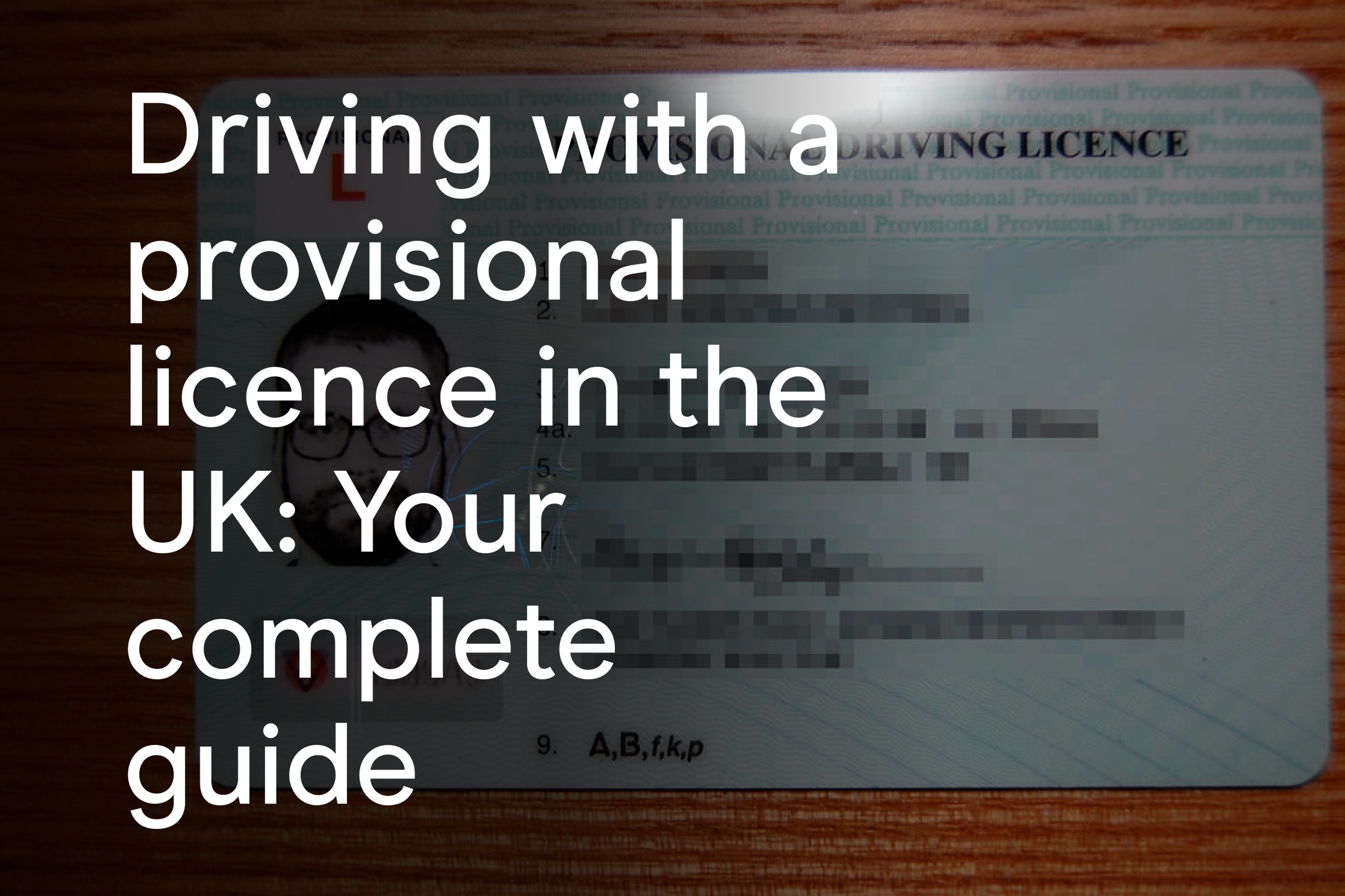
Updated for 2026 — current fees, real test wait times, the 6-point rule that catches new drivers out, and the insurance routes that actually work for learners and first-year drivers.
Learning to drive in the UK in 2026 takes longer and costs more than it used to. DVSA waiting lists for the practical test commonly run 3 to 6 months. Average learners need 45 hours of professional lessons plus 20 hours of private practice. Total cost through to a full licence usually lands between £1,800 and £2,800, before you add the first-year insurance bill.
That's a lot riding on getting the process right first time. Here's the complete picture for provisional licence holders in 2026: the rules, the realistic timeline, and the insurance decisions that shape the first few years of driving.
Can I drive with a provisional licence in the UK?
Yes, you can drive with a provisional licence in the UK, but only under specific conditions. A provisional licence holder must be supervised by a qualified driver aged 21 or over who's held a full UK licence for at least three years, must display L plates (or D plates in Wales) on the front and rear of the car, and must hold valid insurance as a learner. Solo driving on a provisional licence is a criminal offence.
These rules exist because insurers and the DVSA treat learners as high-risk drivers until a full test is passed.
How old do I have to be to drive with a provisional licence?
You can apply for a provisional driving licence from 15 years and 9 months old. You can start driving a car on public roads from your 17th birthday. Drivers who receive the enhanced rate of the mobility component of Personal Independence Payment (PIP) can start driving a car from 16. You can start driving a moped or light quadbike from 16 without the PIP exception.
Before 17, there's no legal barrier to learning on private land with the landowner's permission. Many new drivers take a few off-road lessons at 16 to get ahead.
How do I apply for a provisional driving licence?
Apply online at GOV.UK with proof of identity (passport or Post Office identity check), three years of UK address history, and your National Insurance number. The online fee is £34. The postal fee is £43. Most applications arrive within a week.
You'll need a passport-standard photo (the online system can reuse your passport photo free) and you'll need to declare any medical conditions that could affect driving. Failing to declare a notifiable condition is a criminal offence with a £1,000 fine attached.
Who can supervise me as a learner driver?
A supervising driver must be at least 21 years old and must have held a full UK driving licence for at least three years for the type of vehicle being driven (car, van, or motorbike). They can be a driving instructor, a friend, or a family member. They must not be under the influence of alcohol or drugs at the legal limits, and they must not use a mobile phone while supervising. Breaking either rule carries the same penalties as driving under the influence or using a phone at the wheel.
Two practical points most learners don't realise:
Your supervising driver is legally "in charge" of the vehicle while supervising. If you commit an offence they didn't prevent, they can be prosecuted alongside you.
Professional driving instructors (ADIs) carry their own learner-driver insurance in their own cars. That's why most learning happens in an instructor's dual-control car, not a family car.
What insurance do I need as a learner driver?
Every learner driver needs valid insurance before driving on a public road. Three routes exist:
Named driver on someone else's policy. Adding a learner as a named driver to a parent's policy is common but often expensive, and a fault claim during learning affects the policy holder's NCD, not yours.
Short-term learner driver insurance. Built specifically for learners practising in a friend or family member's car. Cover lasts from a few hours to several months, runs alongside the car owner's existing policy, and doesn't affect their NCD if you have a fault claim. Zego's learner driver insurance is a common route here.
Driving in the instructor's car. Professional driving instructors carry their own insurance covering any learner in their car during lessons. You don't need your own policy for lesson time in an ADI's car.
Learners typically use a combination: ADI lessons for the structured learning, short-term policy on a family car for private practice. The short-term option is usually far cheaper than adding yourself as a named driver for a full year.
What are the rules for L plates?
L plates (or D plates in Wales) must be displayed on the front and rear of the car whenever a learner is driving. The plates must be visible from at least 20 metres away, use standard red text on a white background, and meet the size specified in the Highway Code. Magnetic plates that clip onto a steel body panel are the most common format.
Remove the plates when someone else drives the car. Displaying L plates while a non-learner drives is technically an offence, though rarely enforced.
Can I drive on the motorway as a learner?
Yes, in England, Scotland, and Wales, since June 2018. A learner can drive on a motorway only when accompanied by an approved driving instructor in a car fitted with dual controls. Friends, family, and non-ADI supervisors cannot take a learner on the motorway. Northern Ireland doesn't permit learner drivers on motorways.
Motorway lessons are optional, not required. Many ADIs recommend at least one or two motorway sessions before taking the practical test to build confidence at higher speeds.
How long does it take to pass a UK driving test in 2026?
DVSA practical test waits vary by test centre but commonly run 3 to 6 months across the UK in 2026, with some busy test centres running even longer. Theory test waits are shorter, usually 1 to 3 weeks.
Typical end-to-end timeline from provisional licence to full pass:
Months 1 to 4: apply for provisional, start lessons (40 to 50 hours typical), book theory test and practice.
Months 3 to 6: pass theory test, continue lessons, book practical test (earliest available slot, often months ahead).
Months 6 to 12: take practical test. Many pass first or second time.
Allow a full 12 months from starting lessons to holding a full licence. Rushed learners who try to compress this tend to fail more tests, which costs more than taking the extra time.
What happens in the UK driving theory test?
The theory test has two parts. The multiple-choice section has 50 questions on the Highway Code, road signs, and vehicle safety, with a pass mark of 43. The hazard perception section has 14 video clips showing real road situations, and candidates click when they spot a developing hazard. Pass mark is 44 out of 75.
Both parts must be passed in the same sitting. The current fee is £23. Pass rates sit at around 45 to 50% at first attempt. Study the official DVSA materials and use a reputable theory-test app to prep.
Once passed, the theory certificate is valid for two years. You must pass the practical test within those two years, or you'll have to re-sit the theory.
What happens in the UK driving practical test?
The practical driving test takes about 40 minutes and covers five parts:
Eyesight check. Read a number plate from 20 metres away. Failing this ends the test immediately.
Show-me, tell-me safety questions. Two short questions about vehicle checks and safe operation.
General driving. Around 20 minutes of driving in different road and traffic conditions.
Independent driving. Around 20 minutes of driving while following sat-nav directions or road signs. Roughly 4 in 5 tests use a sat-nav provided by the examiner.
Manoeuvres. One reversing manoeuvre from a set list (parallel park, bay park forwards or reverse, or pull up on the right and reverse back).
The current practical test fee is £62 on weekdays and £75 on evenings, weekends, and bank holidays. Pass rates sit at around 48%.
Should I learn in a manual or automatic car?
Learning manual gives you a full licence (category B) that covers both manual and automatic cars. Learning automatic gives you an automatic-only licence (category B auto) that only covers automatic cars. You can upgrade from automatic to full by taking another practical test in a manual car.
Most UK learners still take the manual test, but automatic pass rates are rising fast as more cars (especially EVs and hybrids) are automatic-only. For drivers who plan to own an electric or hybrid car long-term, learning automatic makes practical sense and often produces a quicker pass.
What's the 6-point rule for new drivers?
Any driver who accumulates 6 or more penalty points within the first two years of passing their practical test has their licence revoked under the Road Traffic (New Drivers) Act 1995. To drive again, you must re-apply for a provisional licence and pass both the theory and practical tests a second time. This rule catches more new drivers out than any other.
The 6 points can come from a single offence or from several smaller ones. Using a mobile phone at the wheel is now a 6-point offence on its own, which means one phone fine in your first two years can cost you your licence. Speeding in a 20 or 30 zone, driving without insurance, and driving without due care and attention are the other common routes to 6 points.
The two-year clock runs from the date you passed your practical test, not the date of the offence. An offence committed in year 2 that gets to court in year 3 still counts if the driving happened in year 2.
How much does it cost to learn to drive in the UK in 2026?
Total cost from first provisional application to passing the practical test typically lands between £1,800 and £2,800 in 2026. Breakdown:
Provisional licence: £34 online.
Theory test: £23.
Practical test: £62 weekday or £75 evening/weekend.
Lessons: 40 to 50 hours at £35 to £45 per hour, typically £1,400 to £2,250.
Supplementary materials: Highway Code, theory-test app, mock tests, usually £20 to £50.
Failed test resits: each failed practical costs another £62, plus extra lessons between attempts.
Learners who pass first time spend less. Those needing multiple retakes can easily exceed £3,000.
What do I do after passing my driving test?
Your provisional licence converts automatically to a full UK driving licence once you've passed the practical test. The DVSA sends the new photocard licence within three weeks. Four things to sort immediately:
Get proper insurance as a qualified driver. Learner insurance policies end the moment you pass. First-year insurance for drivers aged 17 to 24 averages £2,500 to £4,000 in 2026, so this is the big cost to plan for. Telematics insurance like Zego's telematics car insurance is the single most effective way for a new driver to bring the first-year bill down, because it prices on actual driving behaviour rather than age-based assumptions.
Consider a Pass Plus course. This DVSA-approved six-module course covers motorway driving, night driving, country roads, and dual carriageways. Some insurers offer discounts for Pass Plus completion, though fewer than used to.
Remove your L plates. Keep them for if you supervise a learner yourself later.
Watch the 6-point rule for the first two years. The licence you've just earned can be taken away quickly if you pick up penalty points early.
What insurance do I need as a newly passed driver?
Newly passed drivers face the highest insurance premiums on the UK market because statistical risk is genuinely higher in the first year. Three routes typically work best:
Telematics insurance. The biggest single lever for a new driver. A black box or app-based policy prices on how you actually drive, and good scores over the first six months can bring premiums down sharply at renewal.
Named driver on a parent's policy. Works short-term but builds no NCD in your own name. Fronting (declaring a parent as main driver when the car is actually the new driver's) is insurance fraud and is aggressively policed.
Specialist young-driver policies. A few insurers specialise in under-25 cover and price accordingly.
Black box policies often include curfew rules (no driving between 11pm and 5am, typically) which most new drivers find acceptable in exchange for the premium reduction. App-based telematics like Zego Sense don't require a physical black box install, which makes switching cars easier than older hardware-based policies.
FAQs
What's the difference between a provisional licence and a full licence?
A provisional licence lets you learn to drive under supervision with L plates and valid insurance. A full licence lets you drive independently once you've passed both the theory and practical tests.
Can I drive alone with a provisional licence?
No. Solo driving on a provisional licence is a criminal offence, carrying a £300 fixed penalty and 6 points. If convicted at court, the fine is unlimited. It also counts as driving without a suitable licence and will void any insurance on the car.
How long does a provisional licence last?
A provisional driving licence is valid for 10 years from the date of issue. You don't need to renew it while learning, but you do need to convert it to a full licence once you pass the practical test.
Can I take passengers as a learner driver?
Yes, but your qualified supervisor must be in the front passenger seat at all times. Additional passengers in the back are legal but most ADIs advise against it while learning to reduce distraction. Some insurance policies restrict who else can be in the car during lessons.
Can I drive on private land without a provisional licence?
Yes, with the landowner's permission. The Road Traffic Act only applies to public roads and land accessible to the public. Airfields, industrial estate out-of-hours lots, and private courses don't require a provisional licence. Insurance is still recommended because you're not covered by public road insurance on private land.
What happens if I fail my practical driving test?
You can re-book the practical test after 10 working days. Most test centres can offer a slot within 3 to 6 months of the previous attempt, though cancellations sometimes free up sooner. Most learners take 2 to 3 attempts to pass.
Can I drive a hire car as a newly passed driver?
Usually only from 21, sometimes 25. Most UK hire companies have minimum age rules above 17 and often charge a young-driver surcharge for drivers under 25. Always check the hire terms before booking.
References
gov.uk — Apply for your first provisional driving licence. Current fees, documents needed, and application timeline.
gov.uk — New Drivers Act 1995. The primary legislation setting the 6-points-in-two-years licence revocation rule.
DVSA — Driving test pass rates and waiting times. Official data on theory and practical test performance and current waiting times.