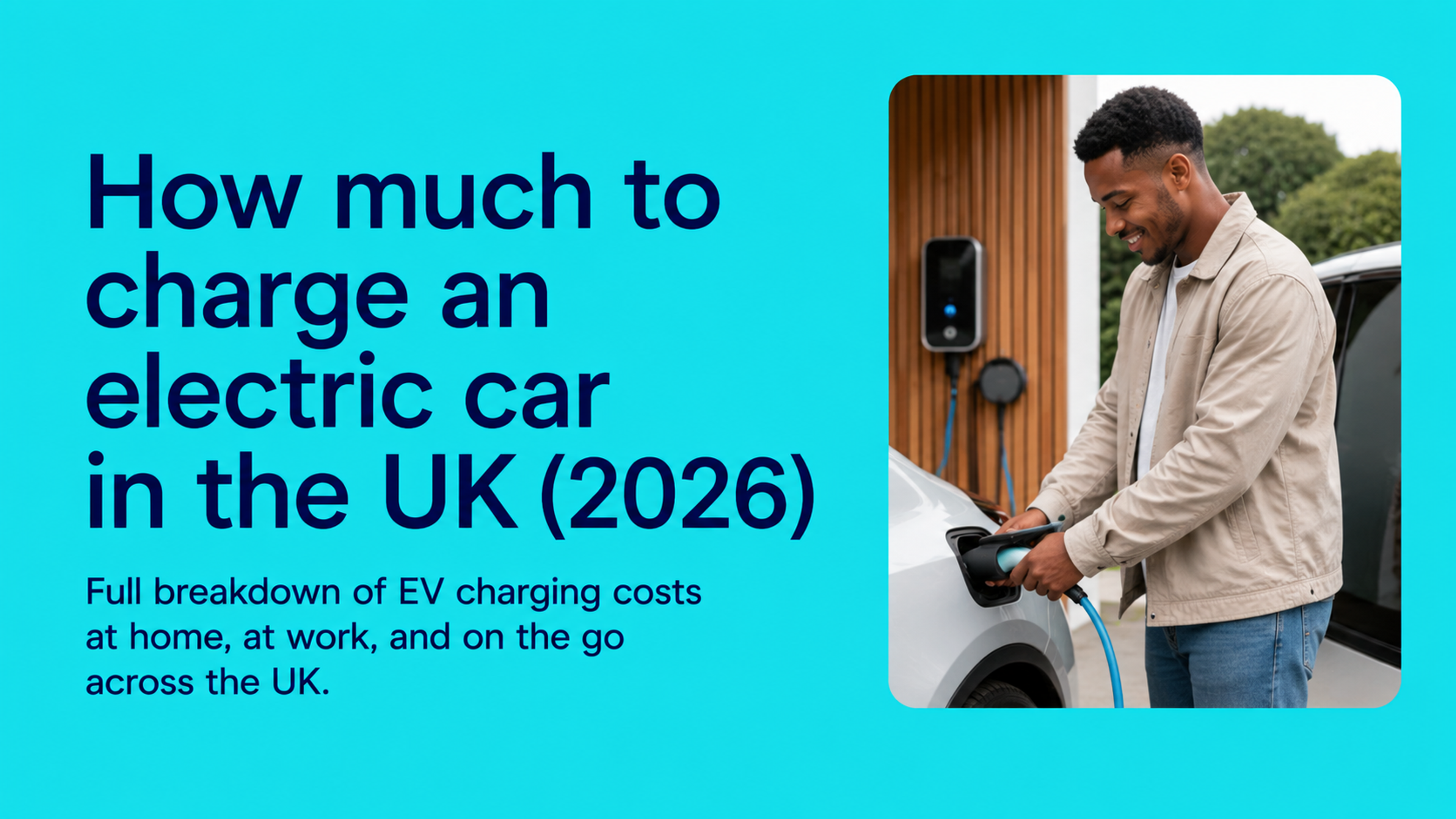
Updated for 2026
Charging an electric car in the UK costs anywhere from around 5p per kWh on an off-peak home tariff to 79p per kWh at a public ultra-rapid charger. For a typical 60kWh battery with roughly 200 miles of range, that is the difference between about £3 to £5 for a full charge overnight and closer to £47 at a motorway services.
So the honest answer to "how much does it cost" is another question: where, and when, are you plugging in? Get that part right and an EV is one of the cheapest things on the road to run. Get it wrong and you can pay more per mile than a petrol car. This guide walks through the realistic scenarios with current 2026 figures, so you can work out your own number rather than someone else's.
Charging at home
Charging at home on a standard variable tariff costs 24.67p per kWh as of the Ofgem price cap for April to June 2026. A full charge of a 60kWh battery works out at around £14.80, and a 100kWh battery at about £24.67.
That rate comes from Ofgem's energy price cap, which sets the average electricity unit rate at 24.67p/kWh for direct debit customers, with a 57.21p daily standing charge [1]. The cap moves every quarter. Ofgem has already confirmed the July to September figure at 26.11p/kWh, so home charging will nudge up a little over the summer.
Here is what a full charge costs at the standard rate across three common
Battery size | Example car | Cost for a full charge (at 24.67p/kWh) |
|---|---|---|
40kWh | Nissan Leaf | around £9.87 |
60kWh | Volkswagen ID.3 | around £14.80 |
100kWh | Tesla Model S | around £24.67 |
These assume a full 0% to 100% charge. In real life most people top up from 20% or 30%, so the cost per session is usually lower. Around 80% of UK charging happens at home, so for most owners this is the rate that matters most.
What you save on an off-peak EV tariff
A dedicated EV tariff changes the maths completely. Off-peak overnight rates currently sit between roughly 5p and 9p per kWh, against 24.67p on the standard cap. That brings a full 60kWh charge down to around £3 to £5.
These tariffs split your bill into a cheap overnight window, usually somewhere between 11:30pm and 5:30am, and a higher daytime rate. You set the car to charge while you sleep and pay a fraction of the standard price.
The market moved in drivers' favour in April 2026. Octopus Energy cut the off-peak rate on its Intelligent Octopus Go tariff, now advertised at 8p/kWh and dropping as low as 5.49p/kWh in some regions [2]. EDF GoElectric, E.ON Next Drive and British Gas sit broadly in the 7p to 9p range. Most need a smart meter, and the fully automated versions want a compatible car or a smart charger such as an Ohme, Zappi or Hypervolt unit.
At 8p per kWh, a full 60kWh charge costs about £4.80. At the standard cap, the same charge is £14.80. Over a year that gap alone is worth several hundred pounds, which is roughly the difference between an EV tariff being a nice idea and being the single best money decision you make as an EV owner.
One detail worth knowing: with the whole-home versions, the cheap rate covers everything in the house during the off-peak window, not just the car. Run the dishwasher and the washing machine overnight and the savings stack up beyond charging.
What it works out at per mile
At the standard price cap, home charging works out at roughly 7p per mile, based on a typical real-world efficiency of around 3.5 miles per kWh. On an off-peak EV tariff at 8p per kWh, that drops to about 2p per mile.
For comparison, a petrol car averaging 40mpg at current pump prices of around 135p per litre costs near 15p to 16p per mile in fuel, according to the House of Commons Library [3]. Even on standard-rate electricity, home charging is roughly half the per-mile cost of petrol. On an overnight tariff, it is closer to a seventh.
Your own figure will vary. A heavy SUV in January might manage 2.8 miles per kWh, while a small hatchback in mild weather can beat 4. Use your car's real number for an accurate sum, but 3.5 is a fair average across the UK fleet.
Public charging
Public charging is the priciest way to power an EV. According to the Zapmap Price Index for May 2026, the weighted average pay-as-you-go price was 54p per kWh on slow and fast chargers, and 79p per kWh on rapid and ultra-rapid units [4].
That works out at roughly 16p per mile on slower public chargers and around 24p per mile on rapid ones. On a per-mile basis, rapid public charging can cost more than running a petrol car, which is the bit that surprises new owners.
Here is roughly what a 60kWh charge costs across the main scenarios:
Where you charge | Typical rate (2026) | Cost for a 60kWh charge |
|---|---|---|
Home, off-peak EV tariff | around 8p/kWh | around £4.80 |
Home, standard price cap | 24.67p/kWh | around £14.80 |
Public slow/fast (PAYG) | around 54p/kWh | around £32.40 |
Public rapid/ultra-rapid (PAYG) | around 79p/kWh | around £47.40 |
Rapid networks vary a lot. Among the top 10 in May 2026, prices ran from 63p to 92p per kWh. Tesla Superchargers, now open to non-Tesla drivers, were among the cheapest at 63p/kWh in daytime hours, while InstaVolt topped the list at 92p/kWh. Believ (66p/kWh) and Sainsbury's Smart Charge (72p/kWh) sit in between [4].
The pay-as-you-go price is the headline rate with no membership. Plenty of networks offer subscriptions, app discounts or time-bound deals, so the real price most drivers pay is often lower than the figure on the screen. It pays to have an app or two and plan around the cheaper stops.
Is there still free charging?
Not really, not any more. Supermarkets led the way with free charging in the early days, but most have switched to paid. Tesco ended free charging back in November 2022 and now charges from 44p per kWh, and Sainsbury's Smart Charge is paid too. A handful of Aldi and Asda stores still have free slower units, but they are the exception now rather than the rule.
If you do want to track down what is left, our guide to free EV charging points and where they actually are goes through it chain by chain. Worth a look, but I would not build your charging routine around it.
How long it takes
A 7kW home wallbox fully charges a typical 60kWh EV in around 8 to 10 hours, adding roughly 25 to 30 miles of range per hour. That is built for overnight charging, which is how most owners use it. A public rapid charger, by contrast, can take you from 10% to 80% in around 30 to 45 minutes, enough for a coffee and a leg stretch.
A standard three-pin plug works in an emergency, but it is slow, often 24 hours or more for a full charge, and not designed to run at full power for that long. For daily life, a dedicated wallbox is the one to have.
Installing a home charger
A 7kW home wallbox typically costs £800 to £1,200 installed. The government's EV chargepoint grant covers up to £350 towards installation for eligible homes, mainly flats and rental properties with off-street parking.
Pairing a wallbox with an EV tariff is what unlocks the lowest overnight rates, so for anyone with a driveway it usually pays for itself fairly quickly. If you can charge at home, the savings against petrol are substantial. If you lean on public charging, an EV is still usually cheaper to run, but the margin tightens and depends heavily on which networks you use.
Which EV charges cheapest?
Battery size and efficiency set your charging bill more than anything else. A small, efficient car sipping 4 miles per kWh costs noticeably less to run than a big SUV doing 2.8, even on the same tariff. If you are still choosing a car, our pick of the best EV cars for new drivers in 2026 leans towards the efficient, affordable end, and drivers using their car for work can find the best electric cars for UK taxi drivers a useful shortlist, since high-mileage drivers feel the cost-per-mile difference fastest.
How charging links to your other running costs
Charging is only one line on the bill. Road tax, servicing and depreciation all factor in too, and our breakdown of electric car running costs in the UK for 2026 maps the lot. Insurance is the other big one, and a common question is whether going electric helps or hurts the premium. Our look at whether car insurance is cheaper for electric cars covers where EV cover actually sits against petrol.
There is also a neat overlap between how you charge and how you insure. EVs reward smooth, planned driving, because hard acceleration drains the battery and regenerative braking works best when you read the road ahead. Those are the same habits that stretch your range between charges, and the same ones a usage-based policy rewards. Zego's telematics car insurance prices cover on how you actually drive, using the Zego Sense app to score your acceleration, braking and focus. If you are curious about the mechanics, our guide on how telematics car insurance works breaks down what gets measured and what moves the number.
The bottom line is simple. Charge at home overnight on an EV tariff and you are looking at roughly 2p a mile, which is about as cheap as motoring gets in the UK. Rely on motorway rapid chargers for everything and the savings shrink fast. The fuel type sets the starting point. How you charge sets the final number.
References
Ofgem, "Changes to energy price cap between 1 April and 30 June 2026" (25 February 2026). Cited for the standard variable electricity unit rate of 24.67p/kWh, the 57.21p daily standing charge, and the 26.11p/kWh figure for July to September 2026.
Octopus Energy, Intelligent Octopus Go (April 2026). Cited for the 8p/kWh off-peak EV charging rate and the reduced regional rates from April 2026.
House of Commons Library, "Petrol and diesel prices" (March 2026). Cited for UK pump prices of around 135p/litre petrol used in the per-mile comparison.
Zapmap Charging Price Index (May 2026). Cited for public charging averages of 54p/kWh (slow/fast) and 79p/kWh (rapid/ultra-rapid), per-mile equivalents, and the 63p to 92p network range including Tesla, InstaVolt, Believ and Sainsbury's.