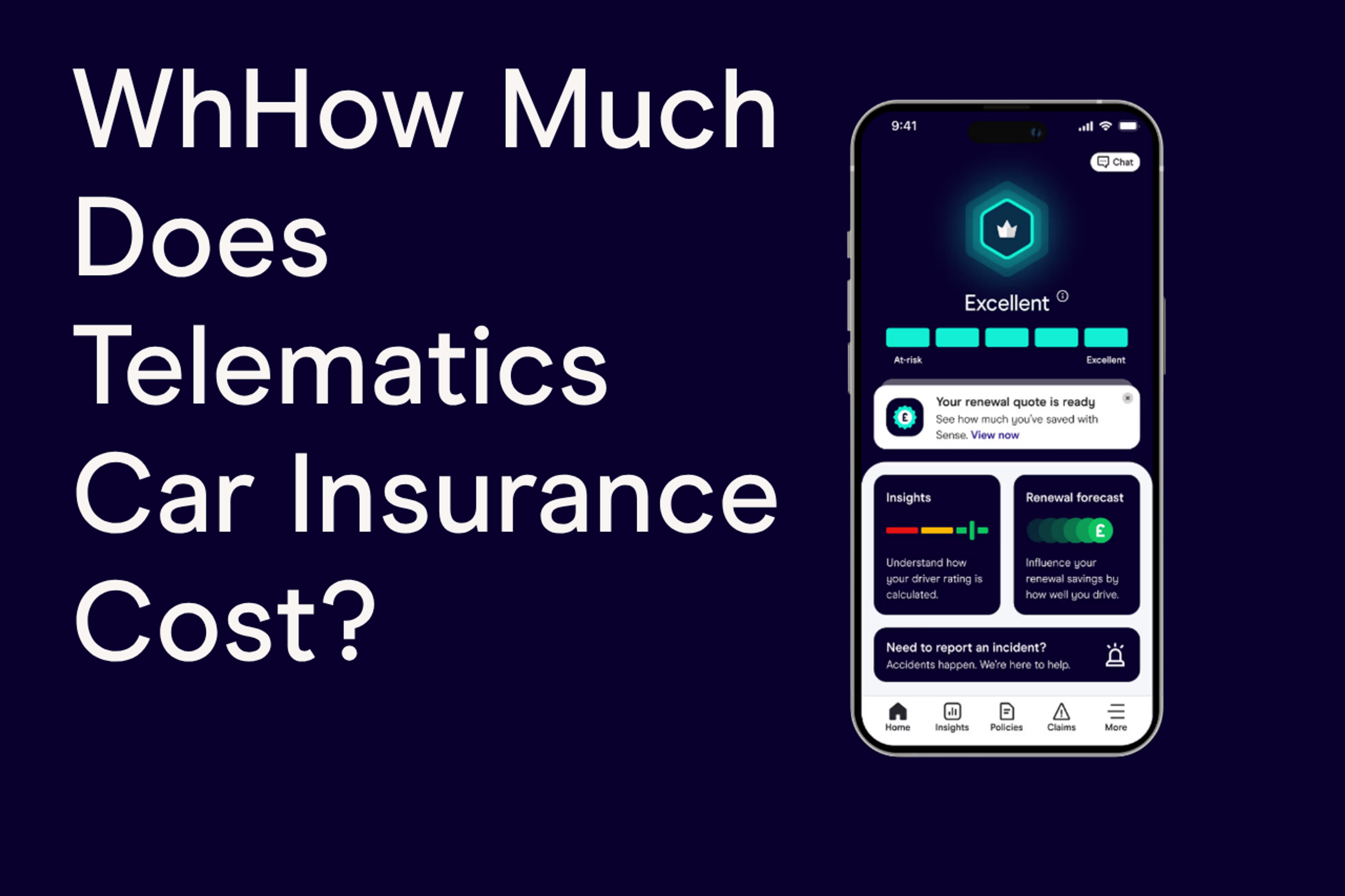
How Much Does Telematics Car Insurance Cost?
Based on UK market research, telematics car insurance typically costs somewhere between £460 and £1,600 per year. The exact price depends on your age, how you drive, what car you have, and where you live. The UK average comprehensive premium was around £551 in Q3 2025, according to ABI data [1].
Safe drivers who keep a strong driving score may pay less when they renew. Research suggests savings of up to 40% are possible for consistently safe drivers, according to Quotezone Q4 2025 data (via Brumble) [2].
Your starting quote works the same way as any car insurance – based on your age, postcode, vehicle, and claims history. The difference is what happens next. Your insurer tracks how you actually drive through an app or fitted device, then adjusts your renewal price based on real data. Drive well, and the cost may drop. That is what separates telematics car insurance from traditional cover.
Zego Sense personal car annual prices start from £578.51*, and 96% of Sense drivers paid less at renewal than their initial premium**. For full details on how Zego prices telematics, see the Zego Sense section below.
How Much Does Telematics Car Insurance Cost by Age Group?
Age is the biggest factor. Younger drivers see the largest gap between telematics and traditional pricing. Here is a rough picture of what each group can expect, based on UK research from 2024–2026.
Aged 17–19 – the biggest potential saving. This age group pays the most for any type of car insurance. For example, a 17-year-old might pay around £1,932 for a traditional policy, according to Quotezone Q4 2025 data [2]. A 19-year-old in Manchester could be looking at around £2,500 traditionally, dropping to roughly £1,600 with telematics, based on a WeCovr (March 2026) example [5]. Research from Consumer Intelligence (reported by Insurance Times, November 2024) found the average gap between traditional and telematics for 17–19 year olds was around £2,172 – big enough that 83% of this age group chose telematics [3].
Aged 20–24 – still a meaningful gap. Premiums for this group are lower but still above average. Quotezone Q4 2025 data puts the range at around £720–£850 for ages 20–25, with the overall 17–24 average at roughly £1,121 [2]. The telematics saving is smaller than for 17–19 year olds, but 78% of drivers aged 17–20 still got a cheaper quote with telematics than without [2].
Aged 25–34 – smaller but still there. Traditional premiums are closer to the UK average of £551 [1]. The gap between telematics and traditional narrows, but safe drivers may still see lower renewal prices as their driving data builds.
Aged 35–49 – steady savings for safe drivers. Traditional premiums tend to sit around or below the UK average. The saving is smaller in percentage terms, but consistent driving can still produce a lower renewal price.
Aged 50–60 – savings still available. Research from Consumer Intelligence (via Insurance Times, November 2024) suggests drivers over 50 could save around £160–£230 on telematics across the wider market [3]. Separately, Zego Sense is designed for the 25–60 bracket – see the Zego Sense section for how it works.
All figures are approximate, drawn from published UK research, and do not represent any single insurer's pricing. Your actual premium depends on your circumstances. Zego's prices may differ.
What 8 Factors Affect the Cost of Telematics Car Insurance?
Your telematics premium is shaped by two sets of factors. The first set – age, postcode, vehicle, and driving history – determines your starting quote. The second set – driving score, consistency, time of day, and mileage – kicks in during the policy and influences your renewal price.
Your Age
Age is the single biggest pricing factor. The UK average premium was around £551 in Q3 2025, according to ABI data [1], but younger drivers pay far more. For example, a 17-year-old might pay around £1,932 on average, according to Quotezone Q4 2025 data [2]. Telematics does not remove this – but it gives younger drivers a way to prove they are safer than their age group suggests.
Your Postcode
Insurers price partly by area. Urban postcodes – parts of London, Birmingham, and Manchester especially – tend to cost more because of higher theft and accident rates. Telematics does not override this at quote stage, but your driving data can help reduce its impact at renewal.
Your Vehicle
Cars are rated by insurance group, from 1 (cheapest) to 50 (most expensive). A group 5 hatchback costs less to insure than a group 30 sports car. The car's value matters too – Zego Sense, for example, requires vehicles valued under £30,000.
Your Driving History
Claims, convictions, and no claims bonus all factor in. For example, according to WeCovr (March 2026), a no claims bonus built up over 9 or more years can reduce your premium by over 70% [5]. Telematics is especially useful if you have not built up a bonus yet – it gives you another way to show you are a safe driver.
Your Driving Score
This is what makes telematics different. Your insurer tracks how you drive – typically measuring acceleration, braking, cornering, speeding, and rest – and turns it into a driving score. A high score may lower your renewal price. A low score can push it up.
Your Consistency
One bad trip does not ruin your score. Most systems use a rolling average – Zego Sense uses a 28-day window, for example. What matters is how you drive over weeks and months, not one harsh brake on a rainy Tuesday.
Time of Day
Some traditional black box policies penalise night driving or impose curfews. App-based providers like Zego do not impose curfews, though your driving patterns may still factor into the overall assessment.
Mileage
This depends on the type of telematics. Pay-per-mile products charge by distance. Behaviour-based products like Zego Sense do not – how far you drive has no direct effect on your premium.
How Much Can You Save With Telematics Car Insurance?
Savings vary widely depending on your age and driving. To give a sense of the range across the UK market:
For a 17–19 year old, Consumer Intelligence research (via Insurance Times, November 2024) found the average gap between telematics and traditional cover was around £2,172 [3]. That is the biggest saving of any age group.
For drivers aged 17–20, 78% got a cheaper quote with telematics than without, according to Quotezone Q4 2025 data (via Brumble) [2].
For drivers over 50, the saving is smaller – research suggests around £160–£230 on appropriate policies [3].
Savings tend to grow at renewal. The insurer has real driving data by then, so your price is based on how you actually drove rather than assumptions about your age group.
None of this is guaranteed. If your driving data shows frequent harsh braking, speeding, or distracted driving, your renewal price may not decrease – and it could increase. Telematics rewards the behaviour, not the policy type.
What does this look like with Zego Sense specifically? According to Zego's published data, 96% of Sense drivers paid less at renewal than their initial premium**. Sense drivers may also earn rewards of up to £60 per year for consistently maintaining an excellent rating***.
**Based on Zego customers with a driver rating, between 01/06/2025 and 01/08/2025 [6]. ***If an 'Excellent' rating is consistently maintained; annual policy holders only [6]. Individual results vary – Zego's prices depend on your circumstances, driving behaviour, vehicle, and risk factors.
Is Telematics Car Insurance Cheaper Than Standard Car Insurance?
It depends on how you drive. For safe, consistent drivers – especially under-25s – UK market research suggests telematics can be cheaper [3]. But the saving usually comes at renewal, not Day 1.
Here is why. Your starting quote uses the same factors as any policy – age, postcode, vehicle, claims history. Telematics does not change that. What it changes is what happens next: your insurer collects 12 months of real driving data, then prices your renewal based on that instead of assumptions.
For safe drivers, that typically means a lower renewal price. For drivers whose data shows higher risk, the price may stay the same or go up. The UK average premium was around £551 in Q3 2025 (ABI data [1]) – across the market, telematics premiums for safe drivers may sit below this after the first renewal.
What Does Telematics Car Insurance Include?
The same cover as any comprehensive policy. Telematics changes how the price is calculated, not what the policy covers.
Standard inclusions typically include personal accident cover, key replacement, windscreen repair, third-party liability, personal belongings protection, courtesy car during repairs, and audio/navigation cover. The specifics vary by provider – always check your policy documents.
Zego Sense, for example, also offers breakdown cover as an optional add-on for an additional cost.
How Does the Driving Score Affect Your Telematics Premium?
Your driving score is the link between how you drive and what you pay. It is generated from data collected by an app or fitted device, and it directly shapes your renewal price.
Most telematics systems track five core behaviours: acceleration (smooth starts vs. rapid ones), braking (gentle stops vs. harsh ones), cornering (steady turns vs. sharp ones), speeding (staying within limits), and rest (taking breaks on longer drives). Some providers track additional metrics too.
The score is not based on one-off events. For example, Zego Sense uses a 28-day rolling average – so one harsh brake does not tank your rating. What counts is the pattern over time.
At renewal, a high score typically means a lower premium. A low score may mean a flat or higher price. The exact relationship varies by provider, but the principle is the same everywhere: better data, better price.
How Does App-Based Telematics Compare to Black Box Pricing?
Both achieve the same thing – pricing based on how you drive – but the cost structure differs.
Installation. Black box policies need a physical device fitted to the car. That means installation and removal fees. App-based telematics uses your phone – no hardware, no fitting cost.
Switching cars. With a black box, changing vehicle means removing the device and refitting it. With an app, it transfers instantly because it lives on your phone.
Real-time feedback. App-based systems can show you your driving data in real time. Black boxes typically cannot.
The actual insurance pricing is similar – the cost difference is mainly in the operational overhead of installing, removing, and moving hardware.
Who Pays the Most for Telematics Car Insurance?
The same groups who pay the most for any car insurance. Telematics reduces the gap but does not eliminate it.
Young drivers. A 17-year-old might pay around £1,932 on average, even with telematics reducing the cost significantly (Quotezone Q4 2025 data [2]). Research suggests the telematics version is around £2,172 cheaper than the traditional equivalent for this age group, but the starting point is still high [3].
Urban drivers. London, Birmingham, and Manchester postcodes tend to attract higher premiums across every policy type due to higher claim rates.
Higher-group vehicles. A telematics policy on a group 30 car costs more than the same policy on a group 5 car, regardless of driving score.
Drivers with claims or convictions. Your history is still factored into the starting quote. Telematics gives you a way back to lower pricing through safe driving data, but it takes time.
How Do You Get the Best Price on Telematics Car Insurance?
Two stages: getting a lower starting quote, then earning a lower renewal price through your driving score.
At quote stage:
Increase your voluntary excess. For example, moving from £100 to £350 typically reduces the premium – but means you pay more if you claim.
Build your no claims bonus. According to WeCovr (March 2026), 9 or more claim-free years can reduce premiums by over 70% [5].
Choose a lower insurance group car. This is the second-biggest pricing factor after age.
Compare providers. Premiums can vary by hundreds of pounds for the same driver. Check comparison sites and direct with providers too.
At renewal:
Maintain a high driving score. Consistent safe driving across all tracked metrics gives the insurer the data to justify a lower price.
Keep the app running properly. If the app cannot collect data, it cannot build the score that earns your discount.
Do not auto-renew without checking. Even with a good score, compare the renewal quote against the market. Loyalty does not guarantee the best deal.
How Does Zego Sense Price Telematics Car Insurance?
The information below is based on Zego's published product details at the time of writing (April 2026). Zego's actual prices, eligibility, and features may change. Visit zego.com for up-to-date information and a personalised quote.
Zego Sense is an app-based telematics product – no black box needed. It prices your renewal based on a driver rating generated from your phone's sensors.
Starting price. Zego Sense personal car annual prices start from £578.51*. Your actual quote depends on your age, postcode, vehicle, and driving history.
Who can get it. You need to be aged 25–60, hold a full or provisional UK licence, have no previous claims or motoring convictions, and drive a car valued under £30,000 for social, domestic, and pleasure use.
What it tracks. The app measures acceleration, braking, cornering, speeding, and rest. Zego also announced phone distraction as an additional metric in March 2026 [7]. Your rating activates after 5 trips covering at least 65 miles, and uses a 28-day rolling average – so one bad journey does not wreck your score.
At renewal. Your driver rating directly shapes your new premium. 96% of Sense drivers paid less at renewal than their initial premium**. Sense drivers may also earn rewards of up to £60 per year for consistently excellent ratings***.
No hardware. The app runs on your phone, tells the difference between driver and passenger automatically, and gives you real-time insights into your driving.
*10% of Zego customers paid this amount or less in the six months prior to 21 October 2025 [6]. **Based on Zego customers with a driver rating, between 01/06/2025 and 01/08/2025 [6]. ***If an 'Excellent' rating is consistently maintained; annual policy holders only [6]. Zego's prices vary depending on driving behaviour, vehicle type, and individual risk factors.
Frequently Asked Questions
Does Telematics Car Insurance Get Cheaper Over Time?
It can. Each renewal is priced against a longer history of real driving data, so safe drivers may see their premium drop year on year. For example, 96% of Zego Sense drivers paid less at their first renewal**.
That said, it is not guaranteed with any provider. Your renewal price depends on your driving behaviour, claims history, and market conditions at the time.
Is Telematics Worth It for Drivers Over 25?
Yes, if you drive safely. The percentage saving is typically biggest for under-25s [3], but drivers aged 25–60 with clean records can still reduce their premiums at renewal.
Zego Sense is designed specifically for the 25–60 bracket. See the Zego Sense section for eligibility and pricing details.
Can Telematics Increase Your Insurance Cost?
Yes. If your data shows frequent harsh braking, speeding, or phone use while driving, your renewal price may not drop – and it could go up. The system works both ways: good driving data may lower the price, poor data may raise it.
Do You Need Wi-Fi or Mobile Data for Telematics?
You need a smartphone with mobile data and GPS turned on. The app runs in the background and uploads data when connected. No separate Wi-Fi is needed, and the data usage is small – roughly the same as sending a few texts per journey.
References
[1] Association of British Insurers, "Three Straight Quarters of Falling Motor Premiums", November 2025. Cited for: UK average comprehensive motor insurance premium of £551 in Q3 2025. abi.org.uk/news/three-straight-quarters-of-falling-motor-premiums
[2] Brumble, "Young Drivers Insurance UK 2026", 2026. Cited for: age-specific premiums from the Quotezone Q4 2025 Car Insurance Index (age 17 average of £1,932), 78% of 17–20 year olds getting a cheaper telematics quote, and savings of up to 40% for safe drivers. brumble.co.uk/guides/young-drivers-insurance
[3] Insurance Times, "Average price gap of £2,172 turns 83% of young drivers to telematics policies", November 2024. Cited for: Consumer Intelligence research showing a £2,172 gap for 17–19 year olds, 83% telematics adoption for that group, and £160–£230 savings for over-50s. Based on 6,868 motor risks. insurancetimes.co.uk/news/average-price-gap-of-2172
[4] Confused.com, "Telematics Insurance Explained", 2026. Cited for: general telematics explanation and the finding that 51% of customers could save up to £529.15 (Consumer Intelligence Ltd, January 2026). confused.com/compare-car-insurance/black-box/telematics-explained
[5] WeCovr, "Telematics UK Insurance Costs 2026", March 2026. Cited for: 9+ year NCB discounts of over 70%, 25%+ renewal savings for good driving scores, and the Manchester 19-year-old pricing example (£2,500 traditional vs £1,600 telematics). wecovr.com/guides/telematics-uk-insurance-costs
[6] Zego, product page and "Telematics vs Black Box Insurance", December 2025. Cited for: *prices from £578.51 (10% of customers paid this or less, six months prior to 21 October 2025), **96% renewal savings (customers with a driver rating, 01/06/2025–01/08/2025), ***up to £60/year rewards (Excellent rating, annual holders only), eligibility, and features. zego.com/car-insurance/telematics | zego.com/blog/telematics-vs-black-box-insurance
[7] Zego, "Phone Distraction: The Newest Sense Driver Rating Factor", March 2026. Cited for: phone distraction announcement as an additional Sense metric. zego.com/blog/phone-distraction-the-newest-sense-driver-rating-factor
All figures are from published UK research and Zego's own data, available at the time of writing (April 2026). Some data is from 2024–2025 and market conditions may have changed. Industry figures are aggregated and do not represent any single insurer. Zego-specific claims are subject to the asterisked caveats (*/**/***) throughout. Zego's actual premiums are determined by their underwriting process and may differ from the market averages above. For a personalised quote, visit zego.com.