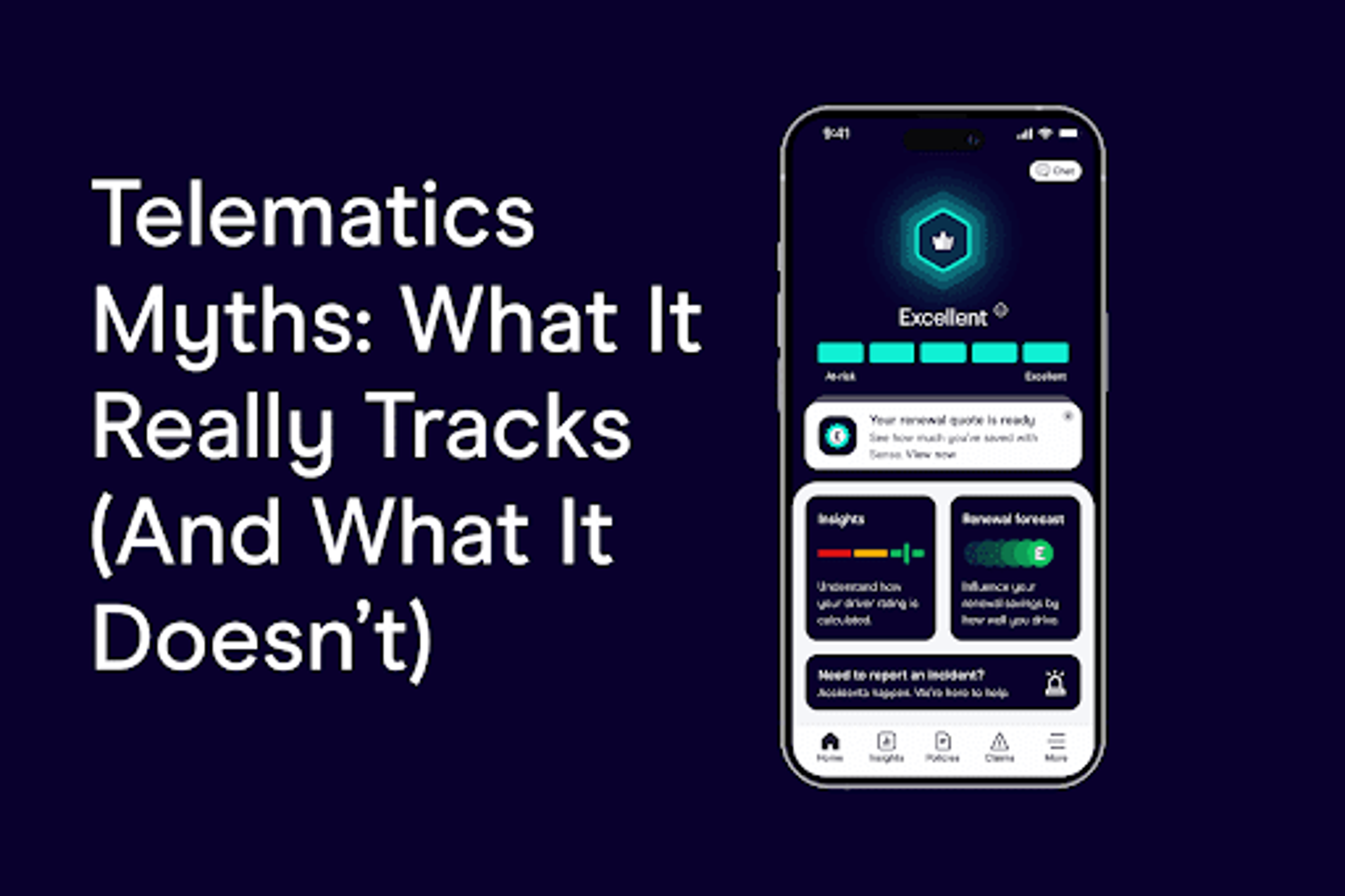
Telematics insurance has a bit of a reputation problem.
Mention it to most drivers, and they picture a "Big Brother" tracker watching their every move, waiting to punish them for driving at the "wrong" time or making one tiny mistake.
In reality, telematics is about driving behaviour, not spying. It’s designed to understand risk on the road so insurers can price policies more fairly.
With Zego Sense, we’ve taken that concept and made it app-based. That means no clunky black boxes and a scoring system designed to be clear, useful, and transparent. If you’re being measured, you deserve to know exactly what is being measured and why.
Let’s clear up the 8 biggest myths.
Myth 1: “Telematics tracks me everywhere I go”
The Reality: It assesses trips, not your lifestyle.
People often imagine a live GPS dot on a map 24/7. But telematics isn’t interested in where you go for lunch; it’s interested in how you drive on the way there.
To understand the basics, it helps to look at how telematics insurance actually works to assess risk. The technology focuses on trip data acceleration, braking, and cornering because that’s what correlates with safety. When you aren't driving, there is nothing meaningful to score.
Myth 2: “I’ll be penalised for driving at night”
The Reality: It’s not "anti-night," it’s just risk-aware.
It is true that night driving can be statistically riskier due to visibility and fatigue. However, modern telematics is sophisticated enough to look at how you drive during those hours, not just the clock.
This is often why drivers ask is telematics insurance cheaper for shift workers or night owls. The answer usually lies in your behaviour: if you drive smoothly and safely, the system generally won't mark you down just because the sun has set.
Myth 3: “If I go 1mph over the limit, I’m doomed”
The Reality: Telematics isn't a speed camera.
This is a huge misconception. Drivers often worry that a single moment of overtaking or creeping over the limit will ruin their policy.
Telematics scoring looks for patterns and consistency. When weighing up if telematics is the right choice for you, remember that consistency matters more than one-off events. It distinguishes between a single moment of flow-with-traffic speed and a habitual "heavy foot."
Myth 4: “Harsh braking always equals a bad score”
The Reality: Sometimes, braking hard is the safe choice.
If a child runs into the road, you brake hard. That is good driving, not bad driving.
Telematics algorithms are looking for repeated, avoidable patterns—like tailgating (following too closely) which forces you to slam on the brakes constantly. Building these consistent habits is exactly how to improve your driver score over time, rather than worrying about a single emergency stop.
Myth 5: “It’s basically a black box bolted to my car”
The Reality: "Black box" is just one type of telematics.
"Black box insurance" is the old mental model: a physical device fitted by an engineer. It helps to understand the difference between telematics vs black box insurance, as modern policies are often entirely app-based.
These newer systems use the sensors already inside your smartphone to measure driving smoothness, removing the need for hardware installation entirely.
Myth 6: “Telematics is only for new drivers”
The Reality: It’s for good drivers.
Telematics became famous with young drivers because it was the only way to get affordable cover. But the logic applies to anyone experienced or new who wants their premium to be based on their actual driving, not just their postcode or age.
The real question isn't your age, but is telematics cheaper for the type of driver you are? If you are a safe driver, standard insurance might be overcharging you to subsidise unsafe drivers. Telematics helps fix that imbalance.
Myth 7: “It’ll ruin my score if I’m a passenger”
The Reality: App-based tech is smart, but it needs your help.
This is a valid question for app-users. If you are on a bus or in a friend's car, you don't want that data counting towards your score.
With Zego Sense, the app is built to detect probable car trips, but learning how to manage your trips involves knowing how to flag these non-driving moments. Keeping your data clean is easy, and it ensures your score is 100% yours.
Myth 8: “It’s just a way for insurers to catch me out”
The Reality: It’s actually a way to prove you’re safe.
Traditional insurance prices you based on "proxies" (who you are, where you live). Telematics prices you based on "truth" (how you drive).
For the vast majority of safe drivers, this is a massive advantage. It allows you to prove you are a lower risk than your demographic profile might suggest, answering the question of affordability with a definitive "yes" for those who drive with care.
How Zego Sense is Different
Zego Sense is our telematics insurance product . We built it to move away from the "black box" stigma and towards something that actually helps you.
How it works:
Instead of installing hardware, you simply download the Zego Sense app. It runs in the background, automatically detecting when you are driving.
What it measures:
It looks at key variables like braking, cornering, and acceleration to build a Driver Score.
Why it matters:
- Fairer Pricing: Your renewal price is influenced by your score. Drive well, and you could pay less.
- Feedback, not judgement: The app gives you insights into your driving style, helping you spot habits you might not have noticed (like late braking).
- Transparency: You can see your score in the app, so you never have to guess how you’re doing.
Frequently Asked Questions
Does Zego Sense drain my battery?
Zego Sense is optimised to run efficiently in the background. While any app using GPS uses some power, we’ve designed it to minimise battery drain so it doesn't interrupt your day.
Can I turn off the tracking?
For the policy to work (and for you to get the benefits of the pricing), the app needs to be active. However, you can always edit trips in the app if it incorrectly recorded you as a driver when you were actually a passenger.
Is my data private?
Your driving data is used to calculate your driver score and insurance premium. We do not sell your personal movement data to third parties.
Is it legal to use a telematics app while driving?
Yes, provided you do not touch the phone to operate the app while the engine is running. You should set the app up before you start your journey and secure your phone in a cradle or a safe place. You can check the official rules on using a mobile phone or sat nav when driving to ensure you stay on the right side of the law.
Why does braking affect my score so much?
It comes down to safety and reaction time. The faster you travel, the more distance you need to stop safely. If you look at typical stopping distances in The Highway Code, you will see that leaving a gap—and braking smoothly rather than suddenly drastically reduces the chance of a collision.
All good — here they are without separators, rewritten cleanly with H3-style, rich headings so they’re ready to drop straight into CMS or be picked up properly by search and AI systems.
Does telematics track your location?
Telematics uses location data only to understand driving behaviour during a trip, not to monitor where you are at all times. It isn’t interested in your destination, routine, or lifestyle, just how the vehicle is driven on the road. When you’re not driving, there’s nothing meaningful to score.
Does telematics track your speed?
Telematics can identify patterns of speeding, but it doesn’t act like a speed camera. A brief moment over the limit won’t automatically damage your score. What matters is consistency over time, for example, habitual speeding versus generally smooth, compliant driving.
Does telematics mean black box insurance?
No. A black box is just one form of telematics. Traditional black box insurance relies on a physical device installed in the car, whereas modern telematics policies can be entirely app-based. These use your phone’s built-in sensors, meaning no hardware, no installation, and no engineer visit.
Does telematics record voice or conversations?
No. Telematics does not record audio, conversations, or anything picked up by your phone’s microphone. It only analyses driving-related movement data such as braking, acceleration, and cornering.
Does telematics track mileage?
Telematics can see when a trip happens and how it’s driven, but mileage alone isn’t usually a key scoring factor. Driving style matters far more than distance a short aggressive journey is riskier than a longer, smooth one.
Does telematics track phone usage?
Telematics apps are designed to measure vehicle movement, not phone activity. They don’t monitor messages, calls, apps, or browsing. However, unsafe driving behaviour, such as erratic movement that could suggest distraction, may negatively affect your score regardless of the cause.
Does telematics reduce accidents?
There is evidence to suggest telematics may help reduce accidents, especially by encouraging smoother driving and greater awareness. Drivers who receive feedback on braking, cornering, and acceleration often adjust their habits